chief-mcp is a
Model Context Protocol server for Chief. It
lets any MCP client — Claude Code, Claude Desktop, Cursor, or Codex — manage
chats, assets, labels, actions, live sessions, skills, and memories directly in
your Chief project.
It is a single static Go binary built on the Go SDK and talks
only to the Chief public REST API.
To get started you need three things: a Chief
Personal Access Token, the chief-mcp binary
(install below), and an MCP client —
Claude Code,
Claude Desktop, Cursor,
Codex, or
VS Code.
Chats, assets, and labels are available now. Actions, skills, memories, and
live sessions require the latest Chief API release and are rolling out — their
tools are exposed but may return errors until then.
Install
Homebrew is the recommended install on macOS:
brew install --cask Storytell-ai/tap/chief-mcp
go install requires a Go toolchain. Prebuilt
binaries for each platform are on the
releases page.
Credentials
A Chief Personal Access Token is required and sent as the API key. Most tools
are project-scoped and also need a project id. Pass credentials as flags or read
them from the environment:
| Flag | Environment variable | Required |
|---|
--api-key | CHIEF_API_KEY | yes |
--project | CHIEF_PROJECT_ID | for project-scoped tools |
--base-url | CHIEF_BASE_URL | no (defaults to https://api.storytell.ai) |
Security
- Treat your Personal Access Token like a password. Pass it through
CHIEF_API_KEY rather than committing it into a client config file.
- A token only reaches the projects it is scoped to. Set
CHIEF_PROJECT_ID (or
the X-Project-Id header in HTTP mode) to bound the server to one project.
--insecure disables TLS verification and is for local development only.
The server exposes 44 tools across seven resources. Chats, assets, and labels
work today; the resources marked ⟳ require the latest Chief API release and are
rolling out.
| Resource | Tools |
|---|
| Chats | create_chat, list_chats, get_chat, update_chat, delete_chat, send_message, list_messages, get_message, delete_message |
| Assets | upload_file, list_assets, get_asset, update_asset, delete_asset |
| Labels | create_label, list_labels, get_label, update_label, delete_label, attach_label, detach_label |
| Actions ⟳ | create_action, list_actions, get_action, update_action, delete_action, enable_action, disable_action |
| Live sessions ⟳ | list_sessions, get_session, update_session, delete_session |
| Skills ⟳ | create_skill, list_skills, get_skill, update_skill, delete_skill, enable_skill, disable_skill |
| Memories ⟳ | create_memory, list_memories, get_memory, update_memory, delete_memory |
Transports
chief-mcp runs as your own process — locally over stdio (the common case) or
self-hosted over HTTP. There is no vendor-hosted Chief MCP endpoint; you run the
binary. Two transports are selected by subcommand:
- stdio (default) — for a local agent that launches the binary as a
subprocess.
- http — for remote or web-based agents. Each request authenticates from its
headers: the API key as a Bearer token in
Authorization (or X-API-Key),
and the project in X-Project-Id.
# Local agent (stdio).
chief-mcp stdio

# Remote agent (http) on :8080 at /mcp.
chief-mcp http --addr :8080 --path /mcp
| Option | Applies to | Description |
|---|
--api-key | stdio | Chief API key (env CHIEF_API_KEY) |
--project | both | Default project id (env CHIEF_PROJECT_ID) |
--base-url | both | API base URL (env CHIEF_BASE_URL) |
--insecure | both | Skip TLS verification (local dev only) |
--debug | both | Dump HTTP requests and responses |
--addr | http | Address to listen on (default :8080) |
--path | http | Path to mount the endpoint on (default /mcp) |
In HTTP mode the server authenticates each request from its headers, so
--api-key applies to stdio only. --project sets the default project for
requests that omit X-Project-Id.
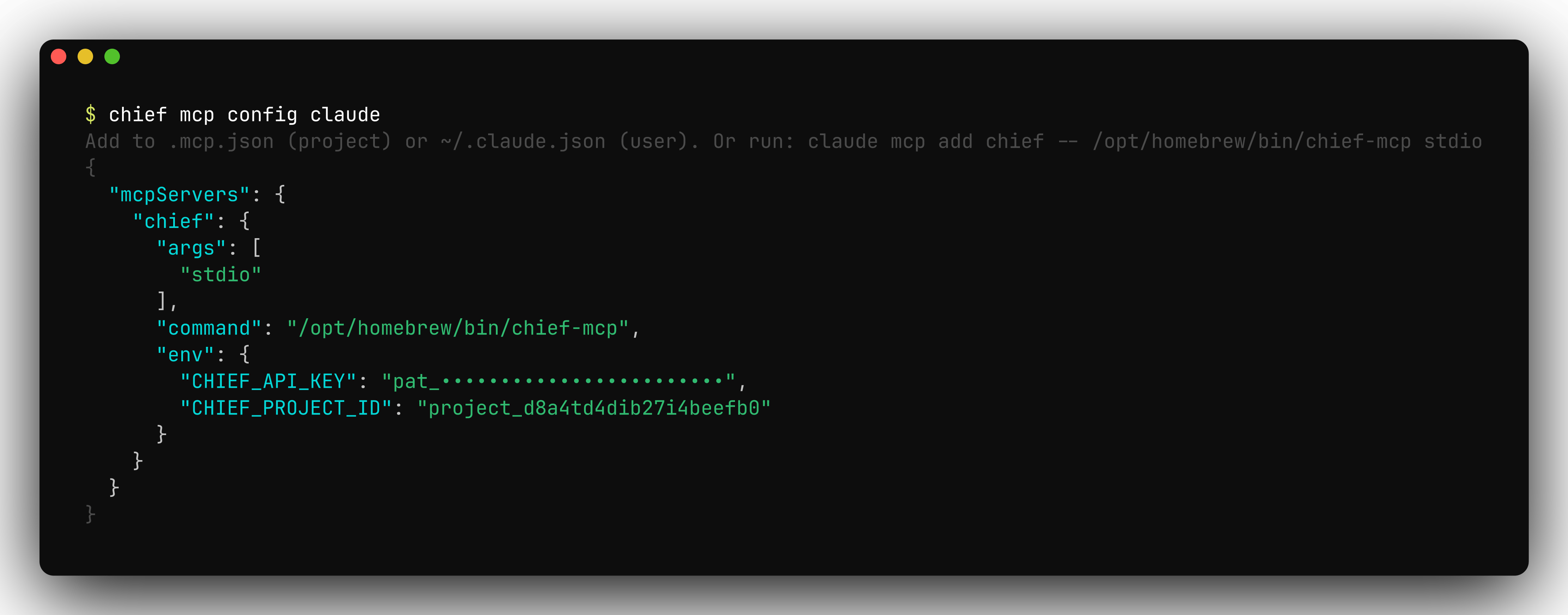
chief CLI, which writes a
ready-to-paste config prefilled with the installed binary path and your
credentials. Install the CLI too, then run:
chief mcp config claude   # Claude Code / Claude Desktop
chief mcp config cursor   # Cursor
chief mcp config codex    # Codex
chief-mcp? Use the hand-written snippets on
MCP clients instead — they need no extra tooling.
For hand-written config and the full per-client setup, see
MCP clients.
Troubleshooting
- Authentication failed — confirm
CHIEF_API_KEY is set in the server’s
environment (or sent as a header in HTTP mode) and that the token is valid.
chief doctor checks credentials and connectivity.
- A tool returns “not found” or an unexpected error — actions, skills,
memories, and live sessions require the latest Chief API release and may not be
available yet.
- The client doesn’t list the server or its tools — restart the client
session. MCP servers are launched once and don’t hot-reload after a config
change.
- Inspect the traffic — add
--debug to dump every HTTP request and response
the server makes.